Introduction
When factoring resource availability in the first world, needs are not resource heavy. Wants are. Wants are a complicated mixture of betterment, greed, status display and social control. The major dynamic is the developed world’s transition from a Christian morality, which permitted a spiritual value system, to a materialist morality, which does not. This leads to a futile and unending search for fulfillment in material things. At the same time, this antinomy undercut Christian orthodoxy, as a societal control mechanism. This is an enormous topic, which cannot be covered here. To avoid being lost in this complexity, this essay will limit itself to the interaction between resource allocation and social control.
Part 1 Great Expectations
On a mundane level and to look at only comparatively recent causes, post the ‘dark satanic mill’ period of industrialization, it is economy of scale which is the core driver. Economy of scale creates a positive feedback loop. More consumption permits larger economies of scale, which reduce costs and so permit more consumption.
However, economy of scale was a problem for a mercantile capitalist empire enabled by the Royal Navy and based on a comparatively small island. Although this small island had a number of important advantages in the pre-industrial and early industrialised periods, size matters. By 1900 both the US and Germany were producing more iron. It was for this reason that WWI was fought. Mercantile capitalism migrated to the US and crushed German productivity. There was a cost. Besides wars burning up resources, the working class demanded the vote in return for their sacrifice. To maintain social control, the ruling order turned to the social control dynamic inherent within economy of scale. Availability of commodities enable buy-in, that is social control by satisfaction of needs and wants. This has two facets: it provides for a broad increase in the standard of living and it provides for a hierarchy of incomes, which links gratification of expectations with identification with the ruling order. Both facets are resource heavy, but the core problem is that as material wealth is not the sole source of human satisfaction, expectations are exponential.
The roaring 20’s was the buy in. The problem was that for every willing buyer there was a more willing seller. It became a feeding frenzy which in the collapse, those most culpable benefitted the most. Out of chaos came order by regulation. The New Deal was the first major step in the West, towards a bureaucratic command society.
The boom depleted resources but so did the bust, although to a lesser scale. In creating a legion of bureaucrats, resource use was substantively untethered from productive labour. The ability to withhold productive labour, acts as a brake on resource depletion. The larger the share of income that is directed towards the non-productive, the less braking there is.
More significantly, without social control by access to material wealth, the ruling class was in danger of losing political control, which was the reason for WWII.
Not seeing Bretton Woods for the Trees
Bretton Woods is commonly seen to be the Post WWII financial ordering of the world. It was more than this. WWI and WWII had both been fought to pass succession of the British Empire to the US and incapacitate European contenders (including Russia). To prevent the depression and radicalization which followed WWI, Bretton Woods was designed to do the following:
convert the US war industry to production of consumer goods.
Insure these goods were affordable by funding an Imperial army, which would enforce resource extraction from the third world, to make up for resource depletion and increased extraction costs in the first world. Colonialism was as much about control of markets as it was extraction of wealth. Neo-colonialism is all about resource extraction.
Conversion of the US war industry to production of consumer goods was swiftly accomplished but the second aim became problematic. It was not just the war in Poland which a “Phony War”, it was phony up until 1944. The Imperial war strategy was to keep out of harm’s way, while Germany and Russia hopefully destroyed each other. However, the Soviet Union emerged intact, weakened as a contender but still a spoiler, who could champion third world resistance. This increased the cost of enforcement and engendered other significant costs. Germany was to have been de-industrialised, but now had to be rebuilt as a Western bulwark, as was Japan in the east.
The Empire had the advantage at first, as Russia had been badly mauled. This is why the US tricked the Soviets into thinking they would not fight in Korea, when they had every intention of forcing a battle. This paid off in the short term. The Korean War ended in July 1953, in August 1953 the British, Americans and Israelis deposed the Iranian government, so as to retain control of the oil industry, without any effective opposition by the Soviets.
In the longer term, as the Soviet Union got back on its feet, it was able to increase the cost of Empire, by backing national liberation movements. The big spend was Vietnam.
The war against Vietnam was not just Imperial power projection. There is a reason why WWII battered France so badly wanted to keep Vietnam and why the British so kindly held it for them, using Japanese troops, until they could return. There was also a reason why the US ended up paying for the major part of the French war effort. The reason was rubber and the power of the Rubber Barons, the inspiration for Conrad’s ‘Heart of Darkness’. When you know who they were, it becomes clear why the US struggled so long and hard to hold onto their plantations for them. Rubber is a core resource.
It was the economic consequences of Empire’s defeat in Vietnam and the Soviets’ support of the Palestinians that gave the impetus for the 1973 oil embargo. The graph below shows that from 1950 to 1973 the price of oil was highly controlled and was slowly decreasing. Curiously for the proposed golden petro Ruble, a barrel of oil during this period was very close to the gold peg. Post 1973 oil prices fluctuate widely but are markedly higher on average. Oil is the resource which unlocks all others and is the major factor in transportation of bulk resources, which underlies the economy of neo-colonialism.
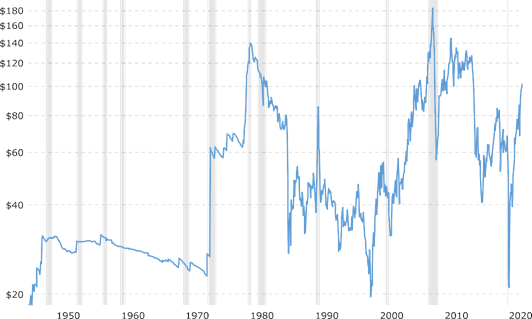
The Empire’s paying for its war in Vietnam, by printing dollars not backed by gold and the collapse of the Bretton Woods agreement is well known. Underneath this was rejection, by a significant number of Americans, of material wealth by resource expropriation. The Empire had a war on two fronts and had to run the printing presses, as it knew War Bonds would not be taken up as required. It was this existential challenge to the primary mechanism of social control which was a factor in the transition of soft power to hard power. In the interregnum, both soft and hard power were deployed and this multiplied resource depletion.
Climbing Tiger Mountain
The Bretton Woods gold standard failed because the total cost, including transport and enforcement, of neo-colonialism was too high. It had to be replaced by another mechanism which maintained social control by satisfaction of material wants, until the inculcation of social mores, which would enable control by a command social structure. This short term structure was called ‘Globalism’ but it was real name was China. This mechanism was directly linked to the Petro-dollar, to mitigate the transport costs associated. There was a double whammy with these costs. Rather than resources being shipped from the third to the first world, they were now double handled, with resources first being shipped to China and thence to the first world. Post the oil embargo, prices were higher and less predictable.
China, as the new sweat shop of the world, was based on Chinese average wages being 1/27 US wages. The prospect currently espoused, of moving industry to other poorer countries, now that Chinese wages have risen to ¼ US wages, is nonsense. There is only one Middle Kingdom. While wages are important, China is unique. Besides having the largest population, it is ethnically homogenous with only two major languages, has a highly disciplined work force and strong infrastructural cohesion. As the chart below shows, China also started from a long way back. NB Japan’s growth rate in the period shows it was the precursor ‘globalised’ nation, which British industry had been moved to.
Table 2 ECONOMIC AND POPULATION GROWTH RATES
| Country | Population (1968) (million) | Average annual growth rate of population (1961-1968) (% Per year) | GNP per capita (1968) (US dollars) | Average annual growth rate of GNP per capita (%per year) |
| People’s Republic of China •——— 730 India——– 524 USSR • —- 238 United States — 201 | 1.5 2.5 1.3 1.4 | 90 100 1,100 3,980 | 0.3 1.0 5.8 3.4 |
| Pakistan —— 123 Indonesia —– 113 Japan 101 Brazil 88 Nigeria 63 Federal Republic 60 of Germany — | 2.6 2.4 1.0 3.0 2.4 1.0 | 100 100 1,190 250 70 1,970 | 3.1 0.8 9.9 1.6 -0.3 3.4 |
The wealth effect of even low wages on a mass scale is not rocket science. Globalisation was always a stop gap measure. Worse it was a stop gap measure which rapidly increased resource depletion, as re-supply of low quality goods magnifies energy costs, both in production, waste management and transport costs. It was not a coincidence that the wheels started to come of when China and other countries refused to continue being the rubbish dumps of the world.
By 2019 Globalisation had run its course. It was no longer an economic means of maintaining social control through satisfaction of material wants, without impinging on the ruling classes dominant position. However, by this time the ruling class’s ideological grip on the majority of the population and its build-up of the police state, meant it was ready to move from soft power to hard power social control.
War Liberalism
Looked at purely as demand destruction, the Lockdowns were comparative to the Great Depression. As a method of social control, it was the first large scale imposition of a command society outside of war. The next step was War Liberalism.
While Russia invaded the Ukraine, this was the result of a provocation as well planned as that which led to WWII. It bears some comparison. The origin of WWII lay in the forcible annexation of Danzig, a free city of Germanic stock, the separation of East Prussia by the Polish Corridor and the subordination of these territories to a harsh Polish rule. In the Ukraine, east of the Dnieper, Cossack lands and the Novorossiya settlement of the ‘Wild Fields’ was subjected to increasingly harsh Ukrainian rule. When Adolf Hitler came to power and attempted to negotiate better conditions for the Germans in Danzig and better access to Eastern Prussia, the British ruling class told the Poles not to negotiate. When the Russian leadership attempted to negotiate better conditions for Russian speakers in Eastern Ukraine, the British ruling class told the Ukrainians not to negotiate.
In both situations the result was a world war. In the nuclear age this cannot be a hot war but all the other features are either in place or falling into place. There is already the alignment into rival camps, a world NATO which does not tolerate neutrality, not even for the Swiss. Then there was the Phony War, now we have the Proxy war. Before long it will ratchet up, the front to watch is the home front. This is because as with WWII. WWIII is being fought for the control of resources. This time it is not so much the exclusion of rivals, from the resources of the third world, but the rationing of scarcity.
Conclusion
To maintain social control in the face of the challenge of democracy, one of the primary tools utilised by the ruling class was satisfaction by material wealth, to adhere the mass of the population to the ruling order. This was resource intensive in itself but compounded by greed, it created an exponential demand on finite resources. Neo-colonialism failed to meet this demand, as the costs of enforcement and transport were higher than projected. Globalism was only ever a quick fix, designed to buy time to lay the social control foundations necessary to marginalize opposition to a command society. Once Globalism faltered, the ruling class moved in two quick steps to secure social control, first pestilence, then war. Next will come famine. This is the way to a sustainable future, for them.
 The Daily Lama